The Douro Valley by Train from Porto
How to visit Pinhão and the Douro Valley by train from Porto — which station, how long it takes, which wineries you can reach on foot, and a one-day itinerary.
The Douro is the rare wine region you can visit properly without renting anything. A railway line runs from central Porto along the river into the heart of the valley, several working quintas sit within walking distance of a platform, and nobody in your party has to nominate a driver and then watch everyone else taste. The catch is that the whole day hangs on the return timetable, and that is the one thing you have to check yourself.
Check Availability
Best Destination: Pinhão, Régua, or further east?
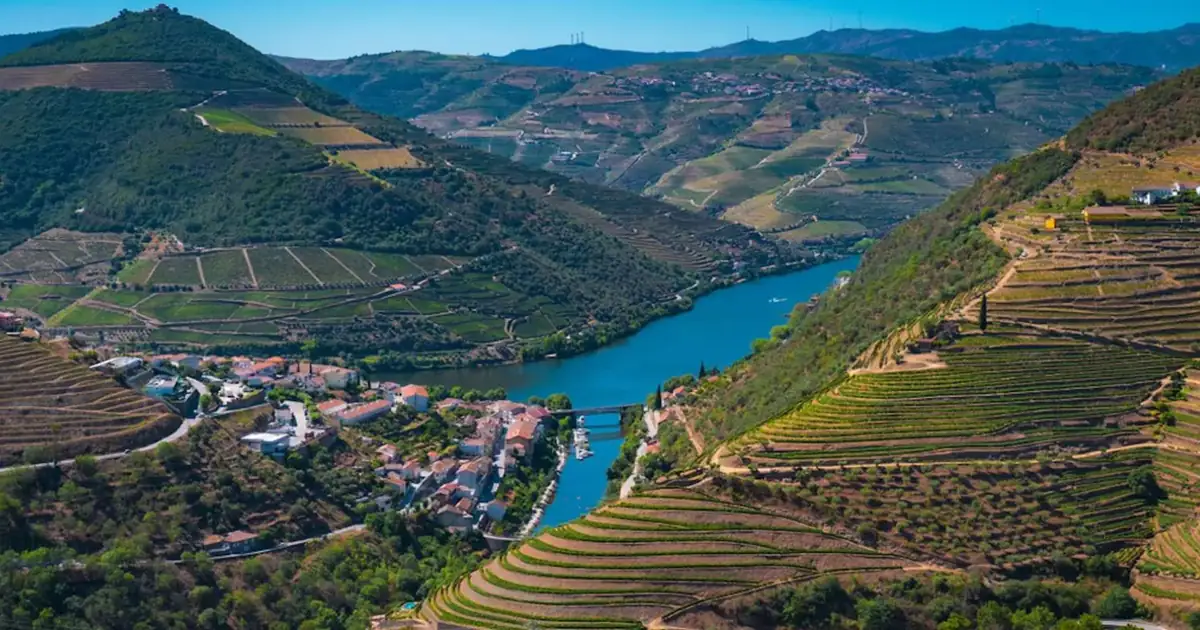
Pinhão is the right railway stop for a first wine visit, and it is not close. It sits at the confluence of the Pinhão river and the Douro in the middle of the Cima Corgo, the sub-region where most of the best Port is grown, and — crucially for a car-free day — the quintas, the cruise dock, the restaurants and the station are all within a few hundred metres of each other. Nowhere else on the line packs a wine day that tightly around a platform.
Peso da Régua is the alternative, and it is stronger on one axis: history. Régua is the bigger town, an hour further west, and it holds the Museu do Douro, which explains the 1756 demarcation and the terrace-building better than anywhere else in the region. But its estates are spread out and none is walkable from the station, so a Régua day needs a taxi booked in advance. Take Régua if you want to understand the valley; take Pinhão if you want to stand in it. Our guides to wine tasting in Peso da Régua and Pinhão wine tours and tastings cover each in depth.
Continuing east — to Tua, Pocinho and the end of the line — is a different proposition. It is a genuinely beautiful rail journey and a poor wine day: the stations are small, the estates are far apart, and the return options thin out sharply. Go east for the train itself, on a trip where tasting is a bonus rather than the plan.
Why the Train Works
Three reasons, and the first is the one that actually decides it.
Nobody has to drive. This is the whole argument. A Douro day involves tasting at one or two estates and usually wine with lunch, and the road back is the N222 — narrow, switchbacked, no shoulder in places. Driving it after a tasting is the bad idea that a train removes entirely, and it means everyone in your group tastes, not everyone minus one.
The journey is part of the trip. The Linha do Douro leaves the city and runs unremarkably for the first stretch, then meets the river and follows it. From roughly Marco de Canaveses eastward the line is right on the water, and the last stretch into Pinhão — terraces stacked above the track on one side, river on the other — is one of the better train rides in Europe. A coach on the motorway shows you none of that.
It is flexible and cheap. A guided day tour fixes your schedule at booking; a train ticket does not. You can leave a winery early, stay for a second glass, or change your mind about the cruise. The trade-off is that you plan it yourself, and the return timetable is a real constraint rather than someone else’s problem.
What the train cannot do: reach the hill villages, the miradouros above the road, or the estates away from the river. If viewpoints and remote quintas are what you came for, that is an argument for a tour or a driver — see the best way to see the Douro Valley from Porto for the full comparison.
Booking the train and what to expect on board
The line is run by CP (Comboios de Portugal) and the Douro services are Regional trains — no reservation, no first class, no catering. Tickets are sold at the station and online, and for a regional service on this line you are generally fine buying on the day, though a summer weekend is a reason to arrive early rather than assume.
Trains leave from Porto São Bento, the tiled city-centre terminus, and call at Campanhã, the main interchange, a few minutes later. São Bento is the nicer start and the one to use if you are staying centrally; Campanhã is the one to use if you are coming in on a longer-distance service. Journey time is roughly two hours to Peso da Régua and about two and a quarter to Pinhão — slower than the road, and that is the price of the view.
Two things worth knowing before you board. Sit on the right-hand side travelling east — the river is on that side for most of the scenic stretch, and the difference between the two sides of the carriage is not marginal. And the good part starts late: the first hour is ordinary suburban and inland scenery, so do not judge the trip from the first thirty minutes.
There is also a historic steam service, the Comboio Histórico do Douro, which runs a short Régua–Tua stretch on summer weekends. It is a heritage excursion rather than transport, it sells out, and it is a poor fit for a wine day — mention it only as a thing to look up if trains rather than wine are the point of your trip.
The day, hour by hour
This is the shape that works. It assumes Pinhão, one winery, and a cruise, and it deliberately leaves slack.
Morning
Take an early train and aim to be in Pinhão before lunch. This is the single highest-leverage decision of the day: the later you arrive, the more the return timetable squeezes everything, and a mid-morning departure turns a relaxed day into a sequence of near-misses. Buy the ticket, find the right side of the carriage, and treat the first hour as travel rather than sightseeing.
Winery
Pre-book one estate. One, not two — a proper visit runs 60 to 90 minutes with the tasting, and two of them plus lunch and a cruise does not fit around the trains.
Quinta do Bomfim is the obvious choice: it is the Symington family’s Dow’s estate and it is a few minutes’ walk from the platform along the riverfront, which removes the only hard part of a car-free day. Quinta das Carvalhas is across the bridge on the south bank and climbs to a ridge viewpoint — a longer, more physical visit and a very good one. Quinta de la Rosa is a couple of kilometres downstream, walkable in about half an hour or a short taxi, and has a restaurant if you want to combine the visit with the meal.
Book it before you leave Porto. Most Douro quintas run visits at set times with limited places and will not take walk-ins, particularly in summer and during the September–October harvest.
Lunch
Leave real time for it. The temptation on a rail day is to compress lunch into the gap between the winery and the cruise, and it is the wrong economy — a proper Douro lunch with a bottle of local red is one of the better parts of the day, and racing it to make a boat you could take an hour later is a poor trade.
Pinhão has restaurants along the riverfront within a short walk of the station. If you would rather eat at an estate, arrange it when you book the visit — quinta lunches need reserving days ahead, not on arrival.
Cruise
A one-hour cruise from Pinhão is the easiest scenic addition to the day, and the stretch of river either side of the village is the most photographed in the valley. Seeing the terraces from the water rather than from a road above them is a genuinely different view of the same landscape.
Pinhão: Douro River Solar Boat Tour with Wine Tasting — 4.81★ from 1,059 reviews, from $23 — is the one to book: a solar-powered boat with no engine noise, an hour on the water, and two wines from the Favaios co-operative poured on board (our breakdown). It leaves from the dock a few minutes from the station, which is what makes it work on a rail day. Our guide to the best Douro river wine cruises sorts the vineyard sailings from the Porto city ones, which are not the same trip.
Second Tasting
If you want more wine, make it a short one. A second full winery tour will not fit and will not be enjoyable if it does — by mid-afternoon you have already tasted at an estate and had wine with lunch, and another hour of cellar walking is diminishing returns.
A tasting room or a wine flight at a riverside bar does the job in twenty minutes and lets you sit down. It also gives you somewhere to be if the train back is an hour away, which is a more common situation than the itineraries admit. Our guide to what to expect at a Douro Valley wine tasting covers how much you have actually drunk by this point, which is usually more than people think.
Return
Check the current CP timetable for your exact date, and do it before you book anything else. This is the one instruction on this page that matters more than the rest of them combined.
Douro line services are infrequent compared with a suburban railway, the last useful return to Porto is earlier than most visitors expect, and timetables differ between weekdays, weekends and seasons. Every itinerary you will read online — including this one — is built on a schedule that may no longer be current. Look it up on CP’s own site for your travel date, note the last two departures rather than only the last one, and build the day backwards from there.
Do that and a car-free Douro day is genuinely easy. Skip it and you will spend the afternoon doing arithmetic instead of drinking wine.
When a tour beats the train
Honestly: often enough that it is worth naming.
Take a tour if you want the valley’s viewpoints and the estates away from the river, if you want two winery visits rather than one, if you would rather not plan around a timetable, or if you are travelling with people for whom a two-hour train each way is itself the problem. A guided day also solves lunch, the cruise and the transfers in one booking.
The classic version is From Porto: Douro Valley w/ Boat Tour, Wine Tasting & Lunch — 4.66★ from 22,465 reviews, from $64 — two estates, a river cruise, a sit-down lunch and the N222 with photo stops (breakdown).
If it is specifically the train you want but not the planning, Porto: Douro Valley Full-Day Boat, Train, and Lunch Tour — 4.75★ from 1,648 reviews, from $152 — builds a guided day around a scenic rail segment plus a boat and a quinta visit, retracing the route the Port barrels actually took (breakdown). It is the most expensive option here, and what you are buying is the rail experience without the timetable risk.
FAQ
Can you visit the Douro Valley by train from Porto? Yes, and it is one of the easier wine regions in Europe to do without a car. Trains run from Porto São Bento and Campanhã along the river to Peso da Régua and Pinhão, and several quintas near Pinhão are walkable or a short taxi from the station. The one thing to plan around is the return timetable.
How long is the train from Porto to Pinhão? Roughly two and a quarter hours, and about two hours to Peso da Régua. That is slower than driving, but the last stretch runs right alongside the river and is the reason to take it.
Which station should I leave from — São Bento or Campanhã? Either; Douro services call at both, with São Bento first. Use São Bento if you are staying centrally — it is the tiled station and the nicer start — and Campanhã if you are connecting from a longer-distance train.
Which wineries can I reach from Pinhão station without a car? Quinta do Bomfim is a few minutes’ walk along the riverfront. Quinta das Carvalhas is across the bridge on the south bank. Quinta de la Rosa is about two kilometres downstream, walkable in around half an hour or a short taxi. All three need to be booked in advance.
Do I need to book the train in advance? Generally no — these are Regional services without reservations, and buying on the day is normal. A summer weekend is a reason to get to the station early rather than to pre-book. What you must check in advance is the return timetable for your specific date.
Is the train or a guided tour better for the Douro Valley? The train if you want flexibility, the scenic journey and a cheaper day; a tour if you want viewpoints and estates away from the railway, two winery visits, or no timetable to manage. Our tour vs train vs car comparison works through cost and time on all five options.
Which side of the train should I sit on? The right-hand side travelling east from Porto, where the river runs for most of the scenic stretch. It makes a real difference on the final approach to Pinhão.
Ready to plan the rest of it? Our guide to Pinhão wine tours and tastings covers the quintas in detail, the Douro Valley wine route maps what lies beyond the railway, and the best wine tasting near Porto puts the rail day alongside the other seven options. Or compare all six tours on the homepage.
Taste the Douro — Wine, Boat & Lunch, One Day
Join 22,000+ travelers who rated this trip 4.7/5. Two wine estates, a river cruise, and a traditional Portuguese lunch — all included. Free cancellation.
Check Availability & Book