Port Wine vs Douro Wine: What's the Difference?
Port and Douro wine come from the same valley but aren't the same drink. Here's how they're made differently, taste differently, and what you'll actually taste on a tour.
If you’ve only ever had Port back home, a Douro Valley wine tasting can be a genuine surprise — most of what’s actually grown and drunk in the valley isn’t Port at all. Here’s what separates the two, and why it matters for what you order at the tasting table.
Check Availability
Port: fortified, sweet, and legally restricted to here
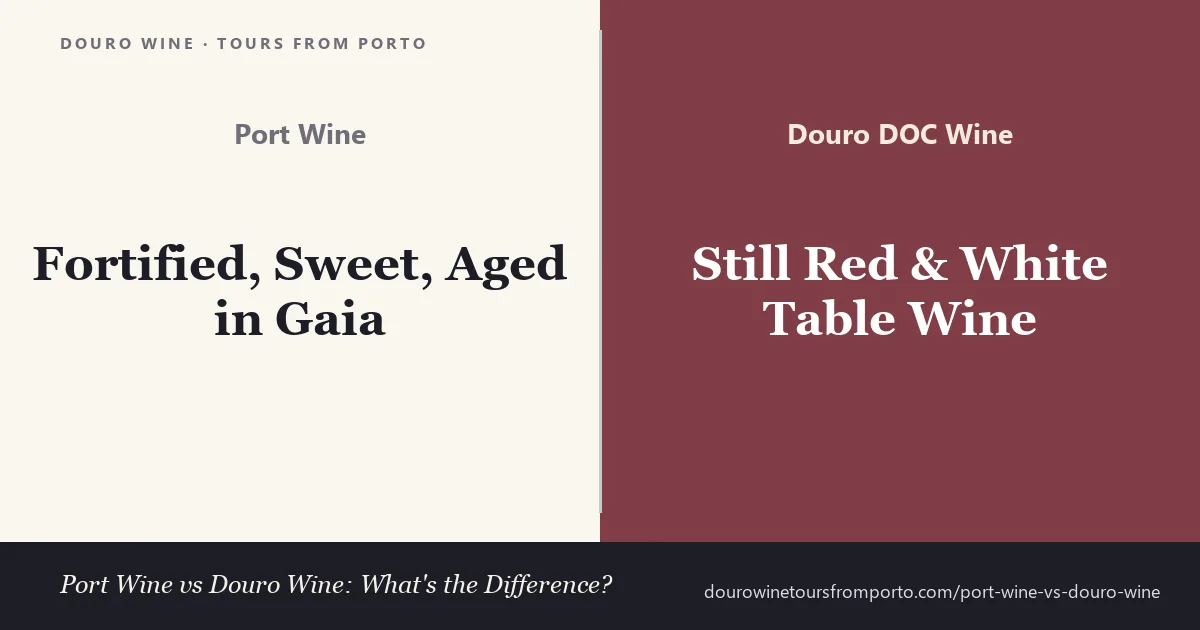
Port is a fortified wine — grape spirit is added partway through fermentation, which stops the yeast before all the sugar converts to alcohol. That’s why Port is sweeter and noticeably stronger (typically around 19–22% alcohol) than a standard table wine. By law, genuine Port can only be made from grapes grown in the demarcated Douro region — the world’s first officially delimited wine region, mapped in 1756 — though a large share of it is then shipped downstream and aged in the cellars of Vila Nova de Gaia, directly across the river from Porto’s old town. Those lodges are visitable in an afternoon — Cálem’s cellar tour is the most-reviewed of them, 4.5★ from more than 5,100 reviews, and our guide to the best Port wine tastings in Porto compares all twelve.
Douro DOC wine: the still red and white you won’t find at home
The Douro region also produces conventional still red and white table wines under its own DOC (Denominação de Origem Controlada) classification — no fortification, no added spirit, just fermented grape juice, the same basic process as a Bordeaux or a Rioja. These are the wines locals actually drink with dinner, and because relatively little of it is exported, it’s genuinely hard to find outside Portugal. If your only reference point for “Douro wine” is a bottle of Port, tasting a Douro DOC red at the estate where it was made is usually the bigger revelation of the two. That means going up the valley: From Porto: Douro Valley w/ Boat Tour, Wine Tasting & Lunch visits two estates and pours both styles across the day, 4.7★ from more than 22,000 reviews (breakdown).
Why tours pour both
Nearly every Douro Valley tour includes tastings of both styles, and it’s worth paying attention to which is which rather than treating the whole flight as “the local wine.” A typical tasting sequence might open with a Douro DOC white, move to a red, and finish with a Port — roughly the order you’d drink them with a meal, ending on the sweetest, strongest pour. Some of the more premium tours go further: our sommelier-led small-group tour tastes 15 wines across a day, including a Vintage Port opened the traditional way — with fire and Port tongs, cracking the neck of the bottle cleanly off instead of pulling a decades-old, crumbling cork (our breakdown).
A quick cheat sheet
| Port | Douro DOC Wine | |
|---|---|---|
| Fortified? | Yes — grape spirit added | No — standard fermentation |
| Alcohol | ~19–22% | ~12–14.5%, typical table wine range |
| Sweetness | Sweet to off-dry | Dry (red or white) |
| Where it’s aged | Often Vila Nova de Gaia | Usually the Douro estate itself |
| Where to find it outside Portugal | Widely exported | Rarely exported |
What to actually order
If you only have room for a few glasses, ask specifically for a Douro DOC red at your first estate stop — it’s the wine you’re least likely to have tried before, and the one you’re least likely to find again once you’re home. Save the Port tasting, and the ceremony that sometimes comes with it, for later in the day. Our guide to Douro Valley wines and what to taste goes further into the grapes, the Port styles and the order to take them in.
Where to taste which
The two styles are easiest to understand in the two places they belong to, and they are not the same trip.
Port, in Vila Nova de Gaia. The lodges are where Port is aged, and a cellar tour explains fortification, cask ageing and the difference between Ruby, Tawny, LBV and Vintage far better than a menu can. It’s an afternoon, not a day, and it’s walkable from Porto’s Ribeira across the Dom Luís I Bridge. Start with Taylor’s Port Cellars & Tasting — 4.6★ from more than 4,800 reviews — or a five-Port tasting with a wine expert if you’d rather taste than walk around, 4.9★ from more than 600 reviews.
Douro DOC, in the valley. The still wines are made and drunk upriver, and the only way to taste them properly is at the estates. Any of the full-day tours pour both, but the wine-focused ones go deeper: From Porto: 2 Wine Regions, Farm-to-Table Lunch & Boat adds Vinho Verde alongside the Douro for ten tastings across two regions, 4.8★ from more than 8,800 reviews (breakdown).
Doing both, in that order, is the version most people enjoy most: the lodges teach you the vocabulary, and the valley shows you what it’s for.
FAQ
Is Port the same as Douro wine? No. Port is fortified — grape spirit is added during fermentation, leaving it sweeter and around 19–22% alcohol. Douro DOC wines are ordinary still reds and whites from the same region, fermented dry at roughly 12–14.5%. Both are legally Douro wines; only one is Port.
Can I taste both on the same tour? Yes, and you should. Nearly every Douro Valley day tour pours both — typically a DOC white, then a red, then a Port — which is the order you’d drink them with a meal.
Which should I buy to take home? The Douro DOC reds and whites, almost always. Port is widely exported and easy to find at home; Douro still wine is barely exported and genuinely hard to buy outside Portugal.
Do I have to go to the Douro Valley to taste Douro DOC wine? No, Porto’s wine bars pour plenty of it. But tasting it at the estate where the grapes were grown, with the terraces in front of you, is the part that changes how you think about it.
What’s the difference between Ruby, Tawny, LBV and Vintage Port? Broadly: Ruby is young and fruity; Tawny is aged in cask and turns nutty and caramelised, sold by age statement (10, 20, 30 years); LBV is a single vintage aged longer in cask before bottling; Vintage is a single exceptional year bottled young and aged in glass. A good beginner flight contrasts a dry White Port, an LBV and a 10-Year Tawny.
Curious which tour gets you the deepest tasting? Compare all six Douro Valley options — including the premium two-region day that adds Vinho Verde wines to the mix — on the homepage.
Taste the Douro — Wine, Boat & Lunch, One Day
Join 22,000+ travelers who rated this trip 4.7/5. Two wine estates, a river cruise, and a traditional Portuguese lunch — all included. Free cancellation.
Check Availability & Book