Best Port Wine Tastings & Tours in Porto: 12 Cellars and Experiences
Compare the best Port wine tours and tastings in Porto and Vila Nova de Gaia — twelve cellars and twelve formats, from self-guided visits to food pairings, Fado and Douro day trips.
Porto is one of the easiest cities in Europe to build a wine-focused day around, and the reason is pure geography: the historic Port lodges sit in Vila Nova de Gaia, directly across the Douro from the city centre, close enough together that you can walk between several of them. The mistake most first-timers make is booking three or four cellar tours and hearing the same introduction three or four times. One complete cellar tour followed by a more specialised tasting is a better day.
Check Availability
Where the lodges actually are
Almost every cellar marketed as a “Porto winery” is not in Porto. The famous names — Taylor’s, Graham’s, Sandeman, Cálem and the rest — are in Vila Nova de Gaia, the historic lodge district directly across the river, not in central Porto. Gaia is a separate city on the south bank of the Douro, and the lodges are clustered along and just above its riverfront. From Porto’s Ribeira district you cross the lower deck of the Dom Luís I Bridge on foot in a few minutes; from the upper deck you can also ride the Gaia cable car down toward the waterfront. Nothing about that is difficult, but it does mean “Porto wine tasting” almost always involves crossing the river, and it pays to group your visits by how far up the hillside a lodge sits rather than picking two at random. Gaia is one end of a supply chain that starts 100km upriver, and Porto: Douro Valley Full-Day Boat, Train, and Lunch Tour is the tour built around that link — it retraces the boat, rail and road routes the barrels travelled down to these very cellars (breakdown).
What a cellar tour actually involves
The lodges vary in atmosphere far more than they vary in format, and knowing the shape of a visit in advance is most of what stops you booking three of the same thing.
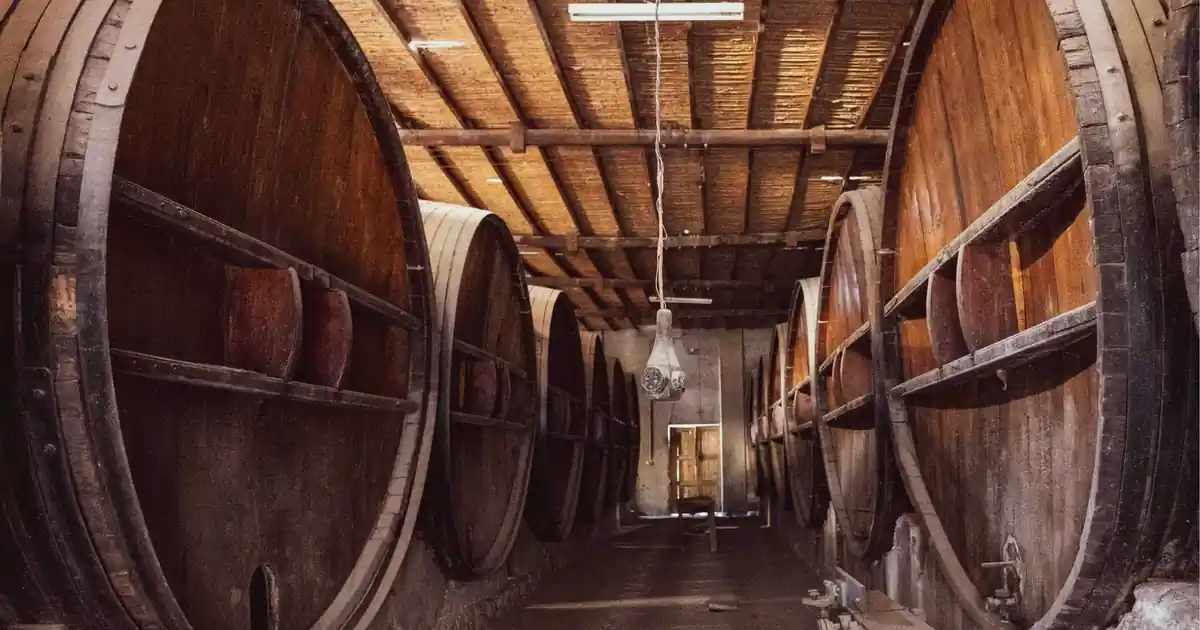
A standard cellar tour runs roughly 45 to 60 minutes and follows the same arc almost everywhere: a short history of the house, a walk between rows of seasoned oak vats and pipes in the cool of the cellar, an explanation of fortification and cask ageing, and a seated tasting of two or three Ports at the end. Some houses run it as a guided walk with a host; others — Taylor’s among them — hand you an audio guide and let you set your own pace, which suits anyone who would rather linger than keep up.
What varies is the tasting at the end. The entry ticket at most lodges pours a Ruby and a Tawny; paying up a tier usually gets you an LBV, an older Tawny with an age statement, or a food pairing alongside. That upgrade is almost always the better value, because the cellar walk is broadly the same whichever ticket you hold.
Two practical notes. First, book online rather than at the door in high season. The price is usually the same, and the popular afternoon slots go. Second, the seated tasting classes and pairing experiences are a different product from a cellar tour and work better as your second stop than your first, once you already have the vocabulary.
Which format of Port experience to book
The twelve houses below are where. This is what shape — because “Port tour” covers at least a dozen different products in this city, and picking the wrong shape is a more expensive mistake than picking the wrong lodge.
| # | Format | Best for | On this site? |
|---|---|---|---|
| 1 | Three-Cellar Walking Tour | A guided overview of several producers in one half-day | No, see below |
| 2 | Single Historic Cellar | Best value if you are comfortable exploring independently | Yes, any of the eight lodges below |
| 3 | Taylor’s Self-Guided Visit | The best independent, structured cellar experience | Yes |
| 4 | Port + Douro Wine Tour | Comparing fortified and dry northern Portuguese wines | Yes, as a Douro day |
| 5 | Port + Food | Tasting in context rather than another production explanation | Yes |
| 6 | Cálem Port + Fado | The best cultural combination | Yes |
| 7 | Port + Chocolate/Cheese | A fun pairing format for beginners | Yes, as a tasting tier |
| 8 | Small-Group Walking Tour | A useful upgrade over large groups | No, see below |
| 9 | Private Port Tour | Serious Port interest or a special occasion | No, see below |
| 10 | City Tour + Port | Short stays where wine is one part of sightseeing | No, see below |
| 11 | Food + Wine Walk | Broader Portuguese wines alongside Port | No, see below |
| 12 | Douro Day Tour | You actually want vineyards instead of Gaia cellars | Yes |
The seven we carry, and what each is really for.
A Single Historic Cellar visit is the one to book first: one house, 45 to 60 minutes, a tasting at the end. Every lodge in the ranking below sells one. Taylor’s Self-Guided Visit is the variant to single out — an audio guide instead of a host, so you set the pace, which suits anyone who would rather linger than keep up. Port + Food is the format to use for your second stop instead of your first: Taste and pair 5 Port wines with a wine expert — 4.9★ from more than 600 reviews — is a seated comparative session with pairings and no cellar walk at all, and it is the highest-rated Port experience on this site.
Port + Chocolate/Cheese is not a separate product here so much as a tasting tier. The pairing is the upgrade you buy on top of a cellar visit. Porto: Graham’s Port Lodge Tour with Premium Wine Tastings — 4.8★ from more than 2,000 reviews — pairs its premium tasting with chocolate, and Porto: Burmester Cellar Tour with Tasting & Pairing Options — 4.5★ from more than 2,000 reviews, sells the pairing as an option on the ticket. Cálem Port + Fado is the one genuine culture-plus-wine combination in Gaia: Porto: Cálem Cellar Tour, Fado Show & Wine Tasting — 4.4★ from more than 3,900 reviews — adds a live Fado performance to the cellar visit, and it is an evening out instead of an afternoon activity.
The last two formats leave Gaia entirely. A Port + Douro Wine Tour — tasting the fortified wine and the region’s dry reds side by side — is not really a Porto product; it happens at the estates, where both come out of the same cellar. So does a Douro Day Tour, which is the honest answer for anyone whose actual interest is vineyards instead of warehouses: From Porto: Douro Valley w/ Boat Tour, Wine Tasting & Lunch — 4.7★ from more than 22,000 reviews, about $100 for the full day with lunch — is the classic version, with two estates, a river cruise and lunch (breakdown). Our guide to Porto or the Douro Valley for wine tasting settles which to do first.
The five we do not carry, and how people actually arrange them.
These formats exist in Porto, but none of them is in our lineup, so we would rather name them plainly than point you at something that is not what you asked for.
- Three-Cellar and Small-Group Walking Tours bundle two or three lodges with a guide who walks you between them. The appeal is real — someone else handles the timing, and a small group gets you more of the host’s attention. They are arranged through local operators in Gaia instead of through us. Be aware that you are often paying a premium for a route you could walk in fifteen minutes yourself, which is exactly the calculation our guide to self-guided wine tasting in Porto works through.
- Private Port Tours are the right answer for serious interest, a special occasion, or a group that wants the pace set to them. They are booked directly with specialist operators or, sometimes, with the houses themselves.
- City Tour + Port combinations bolt a cellar visit onto a Porto sightseeing tour. Sensible on a very short stay; a poor use of a full day if the wine is why you came.
- Food + Wine Walks cover Portuguese wine and food more broadly, with Port as one stop among several. Good for a first evening in the city, less good as your only Port experience.
If you would rather skip the guide altogether, our self-guided Port route covers which bridge deck to cross, four stops in walking order, and how to spend the same money on better wine.
The 12 best Port tastings in Porto and Gaia
1. Taylor’s
A strong first choice for independent visitors. The cellar experience explains Port production and ageing properly, and the tasting that follows contrasts dry White Port, LBV and an aged Tawny — three clearly different styles in one sitting, which is exactly what a beginner needs. If you’re only doing one full cellar tour on the trip, this is the safest pick for getting the whole picture in one go.
Book it: Porto: Taylor’s Port Cellars & Tasting — 4.6★ from more than 4,800 reviews.
2. Graham’s
Choose Graham’s if you want a polished historic lodge with a view, and the option to extend the visit into something more substantial, Port paired with a proper meal instead of a few nibbles. It sits high on the Gaia hillside, so factor the climb (or a taxi) into your plan.
Book it: Porto: Graham’s Port Lodge Tour with Premium Wine Tasting — 4.8★ from more than 2,000 reviews — the highest-rated of the big-lodge tours here with a substantial review base behind the score.
3. Sandeman
Sandeman is the most recognisable name in Gaia — the caped, wide-hatted “Don” silhouette is on half the souvenirs in Porto — and it works well for visitors who want a classic guided cellar experience in a central riverside location. Convenient to reach, easy to combine with a second stop.
Book it: Porto: Sandeman 1790 Historic Cellar Tour & Wine Tasting — 5.0★, but from only 4 reviews so far; this listing is newly on GetYourGuide, so there is far less feedback behind that score than the numbers at Taylor’s or Cálem.
4. Cálem
Cálem is particularly useful if you want a multimedia-style introduction instead of a purely walk-and-talk cellar tour, and it’s also the best known place in Gaia to combine a Port tasting with Fado, Portugal’s melancholy urban folk music. It sits right on the riverfront, so it’s the easiest of the big names to reach on foot.
Book it: Porto: Cálem Cellar Tour, Interactive Museum & Wine Tasting — 4.5★ from more than 5,100 reviews, the most-reviewed cellar tour in Gaia.
5. Ferreira
Ferreira is the most interesting stop for Portuguese Port history specifically. Where several of the great houses were founded by British merchants, Ferreira carries a strongly local identity — choose it if you’d rather hear the Portuguese side of the trade than the British one.
Book it: Porto: Ferreira Visit and Tasting — 4.5★ from 12 reviews, and that is still a caveat instead of a recommendation. This listing’s review history has been unstable: 4.9★ from 22 reviews on 2026-08-31, 4.2★ from 5 on 2026-09-06, and 4.5★ from 12 on 2026-09-12. A count that falls and then climbs again means the product was relisted or its reviews were reset, and twelve reviews is not yet enough to tell you much in either direction. Ferreira stays on this list for the lodge — genuinely the best stop in Gaia for Portuguese Port history — and it is the only Ferreira product on GetYourGuide. If a thin, recently reset rating would bother you, book Taylor’s or Graham’s instead and treat Ferreira as a walk-in.
6. Cockburn’s
Cockburn’s is the pick if you want to see a genuinely large working lodge, with a traditional cooperage — the workshop where oak casks are built and repaired — alongside the tastings. Watching barrels being made is a different kind of visit from watching barrels being stacked.
Book it: Porto: Cockburn’s Port Lodge Tour & Tasting — 4.8★ from more than 4,300 reviews.
7. Fonseca
Fonseca is the useful alternative when the biggest names are booked out or simply too busy. It’s a quieter historic house, and the draw is its own Port styles instead of the scale of the operation — a better second stop than a first one, and a good fit if you’ve already done one large lodge and want the same depth with fewer people in the room.
Book it: Porto: Fonseca Port Wine Cellar Tour & Tasting, 4.2★ from more than 510 reviews. That is the weakest score of the lodges on this page and worth knowing before you book; it is still the only Fonseca cellar product on GetYourGuide, and the complaints tend to be about pacing instead of the wine.
8. Churchill’s
Churchill’s tends to appeal to visitors who want a more contemporary, independent feel than the centuries-old houses offer. It’s the youngest name on this list by some distance, which shows in how the visit is run — less pageantry, more conversation about the wine. Like Kopke, it has no GetYourGuide listing, book with the lodge directly.
9. Burmester
Burmester is exceptionally convenient, sitting right beside the lower deck of the Dom Luís I Bridge, and it often offers good-value introductory and Tawny-focused tastings, including comparative flights that put several Tawny ages next to each other. A good option if you’re short on time, or want a second tasting without committing to another full tour.
Book it: Porto: Burmester Cellar Tour with Tasting & Pairing — 4.5★ from more than 2,000 reviews.
10. Kopke
Kopke is the choice for people who want to focus on the wine instead of the walk-through. It is the oldest of the Port houses, and its strength is aged Tawny and Colheita — single-vintage Tawny aged for years in cask — which is exactly where a tasting-led instead of tour-led format pays off. Kopke has no bookable listing on GetYourGuide, so this is one to walk into or book direct.
11. Port + Food
A food-led Port experience is often more memorable than a second basic cellar tour. Cheese, chocolate and regional dishes do something a plain flight can’t: they show you why the different Port styles exist, because the sweetness and the tannin suddenly have something to push against. Book this as your second stop, not your first.
Book it: Porto: Taste and Pair 5 Port Wines with a Wine Expert — 4.9★ from more than 600 reviews — the highest-rated Port experience on this page once the two newly listed lodges, whose scores rest on a handful of reviews, are set aside.
12. Port + Fado
A Port-and-Fado evening is best treated as a cultural experience instead of the most technical tasting of your trip. You’re paying for the room and the performance as much as for the pour, which is fine, as long as you’re not expecting a 10/20/30-Year vertical alongside it.
Book it: Porto: Cálem Cellar Tour, Fado Show & Wine Tasting — 4.4★ from more than 3,900 reviews. It pairs the Fado show with the Cálem cellar visit, so it doubles as the cellar tour if you only have one evening.
Which tasting to book, at a glance
| Experience | Best for | Rating | Book on GetYourGuide |
|---|---|---|---|
| Taylor’s | A complete first introduction | 4.6★ (4,742) | Cellar tour & tasting |
| Graham’s | A polished lodge with a view | 4.8★ (2,024) | Lodge tour, premium tasting |
| Sandeman | The classic guided cellar | 5.0★ (4) | 1790 historic cellar tour |
| Cálem | Multimedia intro, easiest to reach | 4.5★ (5,111) | Cellar, museum & tasting |
| Ferreira | Portuguese Port history | 4.5★ (12) | Visit and tasting |
| Cockburn’s | A working lodge and cooperage | 4.8★ (4,256) | Lodge tour & tasting |
| Fonseca | A quieter historic house | 4.2★ (513) | Cellar tour & tasting |
| Churchill’s | A contemporary, independent feel | — | Not listed — book direct |
| Burmester | Convenience and value | 4.5★ (2,013) | Cellar tour & pairing |
| Kopke | Aged Tawny and Colheita | — | Not listed — book direct |
| Port + Food | Understanding why the styles differ | 4.9★ (603) | 5 Ports with a wine expert |
| Port + Fado | An evening out | 4.4★ (3,950) | Cálem cellar & Fado show |
How to choose
The strategy that works for almost everyone is this: choose one full historical cellar tour, then use your second stop for a contrasting premium tasting. The first visit gives you the process — how Port is made, why it’s fortified, what the casks are doing — and the second gives you the wine, without repeating an introduction you’ve already had. Doing it the other way round works too; doing two of the same thing does not.
For a first tasting, look for contrasting wines instead of the largest number of pours. White Port, LBV and a 10-Year Tawny make an excellent beginner progression — three genuinely different things, not three variations on one. If you already know you prefer Tawny, skip that progression and look for a 10/20/30-Year comparison instead, which shows you how another decade in cask changes a wine.
Two things are worth knowing before you book. A tasting flight is not the same as a cellar tour — some of the best pours in Gaia come with the least walking around. And the styles you’ll be offered here are the same ones poured at the estates upriver, so if you’re planning both, treat the lodges as the theory and the valley as the practice — From Porto: Douro Valley w/ Boat Tour, Wine Tasting & Lunch is the classic full day out to those estates, with two wineries, a river cruise and lunch, about $100 for the full day with lunch (breakdown). If you want the difference between Port and the Douro’s still wines explained before you spend money on either, our Port wine vs Douro wine breakdown covers it in a couple of minutes.
FAQ
Which Port wine tour should I book in Porto? For a first visit, one guided cellar tour at a single historic lodge is enough. It gives you the process, and every house below sells one. Use any second booking to go deeper into whichever style you liked most instead of repeating the introduction: a seated pairing session if you want the wine explained, Cálem’s Fado evening if you want an occasion, or a Douro day trip if what you actually wanted was vineyards. The format table above maps all twelve options.
How many Port cellars should I visit in Porto? Two is enough for most visitors — one full cellar tour and one specialist tasting, such as a food pairing, a Tawny flight or a Fado evening. A third introductory lodge usually just repeats the first. If you have a full extra day, spend it in the Douro Valley instead of on a fourth cellar.
Are the Port cellars in Porto or Vila Nova de Gaia? In Gaia. The famous lodges are on the south bank of the river instead of in central Porto, although they are easily reached on foot from Ribeira across the lower deck of the Dom Luís I Bridge.
Do I need to book Port tastings in advance? At the larger lodges you can often walk in outside peak season, but the guided cellar tours run at set times in set languages, and the specialist tastings — food pairings, aged Tawny flights, Fado evenings — fill up. Booking ahead costs nothing and saves you waiting in a courtyard for the next English-language slot.
Should I visit the Douro Valley as well? If you have the day, yes. Gaia is where Port is aged; the Douro Valley is where it’s grown, and the terraced landscape is the part you simply cannot see from inside a cellar. From Porto: Douro Valley w/ Boat Tour, Wine Tasting & Lunch covers it in one day from Porto; From Porto: 2 Wine Regions, Farm-to-Table Lunch & Boat adds the Vinho Verde region and a Vintage Port opened with fire, if you’d rather go deeper than wider (breakdown). Our guide to the 10 best wineries and vineyards in the Douro Valley covers what a day upriver actually looks like, and how to choose the best Douro Valley wine tour from Porto covers which format to book.
Once you’ve tasted your way through Gaia, the obvious next step is the other end of the supply chain. The most literal version of that trip is Porto: Douro Valley Full-Day Boat, Train, and Lunch Tour — it retraces the exact route the barrels once travelled down to these cellars, by boat, by the Douro railway line, and by road, finishing at a Quinta instead of a lodge (our full breakdown). Or compare all six Douro Valley options side by side on the homepage.
Taste the Douro — Wine, Boat & Lunch, One Day
Join 22,000+ travelers who rated this trip 4.7/5. Two wine estates, a river cruise, and a traditional Portuguese lunch — all included. Free cancellation.
Check Availability & Book