The Best Time for a Douro Valley Tour Depends on What You Want
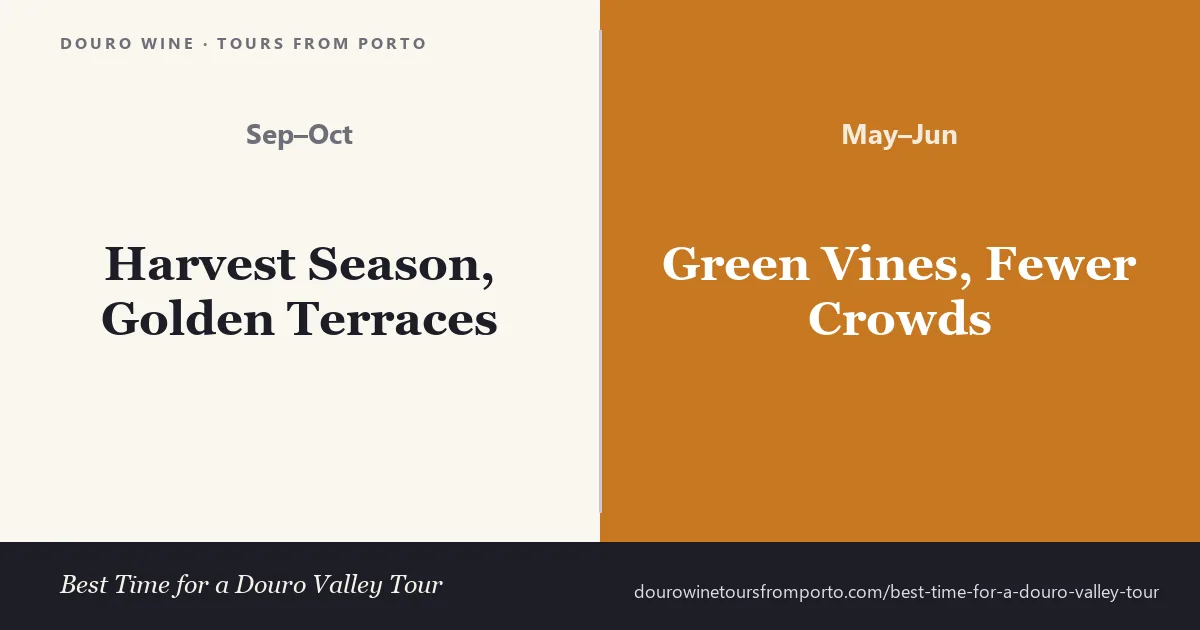
Late May offers the best overall balance for a Douro Valley tour, September is better for the harvest (small-group tours cap at 8 guests), and summer highs average near 29°C. Compare all 12 months and check your travel date.
Porto locals call the Douro Valley “nine months of winter and three months of hell” — an exaggeration, but the temperature swing between the coast and the valley is real enough to plan your day around. Here’s what changes month to month, when the harvest actually happens, and a live check for your own travel date.
Check Availability
Check Your Travel Date
Pick your date and the card below updates with what the Douro is actually doing that week -- the harvest, the heat, and how busy it usually is.
Sep falls inside the Douro's usual harvest window (peak picking across the valley). Small-group and sommelier-led tours book up in this window, so reserve ahead.
- HarvestPeak picking across the valleyADVID / IVDP window
- WeatherAround 25.2°C by day, 48.9 mm of rain in the month (average high)long-term average for Sep (IPMA, Vila Real)
- CrowdsOne of the region's 4 busiest months -- book aheadINE, via CCDR-N (Norte-wide proxy)
- DaylightSunset around 19:41 (12.52 h)Computed for the Douro's latitude
Porto: Douro Valley Wine Tour with a Sommelier & Boat Trip, from $159.
For a detailed comparison of the two autumn months, see October and November wine tours, with cruise schedules, packing advice and tour options.
Late May Into June: The Best Overall Balance
This stretch wins on the combination that matters most for a first visit, not on any single measurement. The vines are lush and fully in leaf, days are warm without the valley’s true summer intensity, and estates are noticeably quieter than they get in September, which means more relaxed tastings and a realistic shot at booking the classic full-day tour the same week you decide to go. Wildflowers are still out along the roadside on the drive in, which disappears by the time the harvest crowds arrive.
The trade-off is honest, not hidden: you give up the working-estate energy of harvest and the deep colour of the autumn vines. From Porto: Douro Valley w/ Boat Tour, Wine Tasting & Lunch — two estates, a river cruise and lunch — is the easiest of this site’s tours to book at short notice in this window, at 4.7★ from more than 22,000 reviews (breakdown).
The Vine and Harvest Cycle, Month by Month
Weather frames a month in the Douro; the vine itself is what actually changes what you’ll see, and the region’s own growers’ association, ADVID, tracks it stage by stage every year.
Budbreak arrives in March or April, and the bare wire-and-stem look of winter gives way to a faint green haze within a couple of weeks. Flowering follows six to thirteen weeks later, usually in mid-spring, and lasts about ten days. Through early summer the canopy fills in and the grapes develop, then veraison — the colour change in the grape itself — starts the clock on harvest: 35 to 55 days later, depending on the variety and the year’s weather, the grapes are ready to pick.
That puts picking anywhere from late August (early whites and the base wine for sparkling) into October (the last reds, picked for tannin ripeness rather than sugar). It’s a genuinely different vintage each year: 2025’s growing season ran 11 to 16 days ahead of its historical average at every stage, so “September” as a rule of thumb has been arriving earlier than it used to.
Here’s the part that’s easy to assume wrong: the vine leaves themselves don’t turn gold and copper while the picking is happening. That colour change is a separate, later event — mostly October, continuing into November as the leaves drop and the plant goes dormant for winter. If the postcard image of golden terraces is the actual reason you’re timing your trip, October beats September for it, even though September is when the valley is more visibly at work.
Why the Douro Runs Hotter Than Porto, and Colder in Winter
The saying about nine months of winter and three months of hell has a real basis in the region’s geography: the Marão mountains cut off the Atlantic’s moderating influence, so the inland valley swings further in both directions than the coast you’re probably starting from.
In August, the Douro’s official climate normal averages a high of 29°C against Porto’s 25°C, and the valley floor towns the tours actually visit, such as Pinhão, sit lower and hotter still than the plateau station that figure comes from. At its hottest it goes much further: the valley’s on-record high is 39.6°C, set in August 2018. Roughly two weeks of an average August cross 30°C entirely, which is the real reason to prioritise a boat cruise and an early start over a midday hillside stop in high summer.
Winter runs the other way. Overnight frost is a normal occurrence from November through March, not a rare cold snap, and several of the smaller family-run estates simply see less foot traffic in these months. Rain is heaviest from October through December — all three months average over 120mm, which is a monthly total instead of a daily rate and says nothing about how many separate days it fell on.
September Into Early October: The Harvest
This is the Douro at its most alive, and the honest reason to plan around it. The estates are visibly working — pressing under way, seasonal pickers in the rows, and some tours build in a treading session in a traditional stone lagar. It’s also the busiest and most booking-constrained stretch of the year for this site’s own products, for a reason you can check directly: the small-group and sommelier-led tours cap at eight guests, and those seats go first.
Porto: Douro Valley Wine Tour with a Sommelier & Boat Trip is the one to book earliest if harvest is the reason you’re going, 5.0★ from more than 820 reviews (breakdown). If you want a bigger day built around the same season, From Porto: 2 Wine Regions, Farm-to-Table Lunch & Boat adds Vinho Verde and runs its own private cruise on a quieter stretch of river, a real advantage when the main channel is busiest — 4.8★ from more than 8,800 reviews (breakdown).
No strong priority: the classic full day
From Porto: Douro Valley w/ Boat Tour, Wine Tasting & Lunch covers two estates, a river cruise and lunch, and books easiest outside September. About $100 for the full day with lunch, 4.7★, more than 22,000 reviews.
The harvest is the point
Porto: Douro Valley Wine Tour with a Sommelier & Boat Trip caps at 8 guests with a certified sommelier guiding. From $159, 5.0★, more than 820 reviews.
Fixed dates in deep summer
Pinhão: Douro River Solar Boat Tour with Wine Tasting keeps you on the water on a near-silent solar boat instead of a hillside stop. From $22, 4.8★, more than 1,000 reviews.
Winter, budget, or a cellar-focused day
Porto: Douro Valley with Lunch (Optional), Tastings & Cruise still runs through winter and stops in Amarante on the way. From $57, 4.7★, more than 9,100 reviews.
How Crowded It Actually Gets
Regional statistics settle this better than a guess. Portugal’s tourism authority for the north (CCDR-N, drawing on INE’s own hotel and accommodation survey) ranks the Douro as the single most seasonal sub-region in the whole of northern Portugal in 2024 — a bigger swing between its busiest and quietest months than Porto itself or any of the other seven sub-regions the region is split into. Across the wider north, August, July, September and May were 2024’s four busiest months for overnight stays, together accounting for close to 44% of the year’s total.
That figure covers hotel and guesthouse stays across the whole region, not day-trip wine-tour bookings specifically, and most people doing a Porto-based day trip sleep in Porto instead of the Douro, so treat it as the best available signal of regional demand pressure, not a headcount of who’s in the tasting room with you. What it does confirm is the pattern this page is built around: the Douro’s calendar has real peaks and real quiet stretches, more so than most of Portugal, and booking ahead in August, July and September matters more here than almost anywhere else in the country.
Month by Month, at a Glance
| Month | Douro typical high | Rainfall (month total) | Vines | Best for |
|---|---|---|---|---|
| Jan | 10°C | 129mm | Bare, pruned | Price, quiet cellars |
| Feb | 12°C | 84mm | Bare | Quiet, still cold |
| Mar | 16°C | 91mm | Budbreak begins | First growth, still low season |
| Apr | 17°C | 85mm | Green haze filling in | Mild, unpredictable rain |
| May | 21°C | 63mm | Fully in leaf, flowering | All-round good conditions |
| Jun | 25°C | 29mm | Deep green | Long days, still comfortable |
| Jul | 29°C | 13mm | Grapes ripening | Reliable sun for the cruise |
| Aug | 29°C | 22mm | Veraison, colour changing | Hottest, boat over hillside |
| Sep | 25°C | 49mm | Picking under way | The harvest itself |
| Oct | 19°C | 121mm | Last reds picked, leaves turning gold | Colour, without peak crowds |
| Nov | 13°C | 123mm | Leaves falling, dormant | Cellar-focused days |
| Dec | 10°C | 143mm | Bare | Cheapest, quietest |
Whatever month you go, the tastings, the river and the terraces are the same three ingredients — what changes with the season is how they look and feel when you get there.
Frequently Asked Questions
The short answers behind the numbers above.
There isn't one answer for everybody. Late May into June gives the best overall balance of comfortable weather, green scenery and easy booking. September into early October is better if seeing the harvest matters more to you than any of that.
Yes, with adjusted expectations. Tours still run every month, prices are at their lowest, and the region's own tourism statistics show this as genuinely its quietest stretch, not just its cheapest. The vines are bare, so the wine, the cellars and the conversation carry the day instead of the view.
Meaningfully, especially in summer. Official IPMA weather-station normals put the Douro's average August high at 29°C against Porto's 25°C, and the valley-floor towns the tours actually visit, such as Pinhão, run hotter again. The Douro's on-record high reached 39.6°C, in August 2018.
Often, yes, mainly from late August into October depending on the variety, and some tours include a treading session in a traditional stone lagar. The exact start moves by two to three weeks each year depending on the weather, and Portugal's Douro wine institute does not publish one fixed date for the whole region, so treat it as a genuine possibility, not the reason you booked.
Not exactly. The picking itself peaks in September. The vine leaves that turn the terraces gold and copper mostly change colour afterwards, in October and into November, so if that specific look is what you're after, aim for October instead of September.
Yes. Portugal's national statistics office recorded the Douro as the most seasonal tourism region in the whole of northern Portugal in 2024, more concentrated into a few peak months than Porto or any other sub-region there.
How We Know
- Temperature and rainfall
- 1991-2020 climate normals from IPMA, Portugal's national meteorological service -- station Vila Real (no. 567, 561.5 m) for the Alto Douro, cross-checked against Porto / Pedras Rubras for the Porto comparison. IPMA's nearest official normals station to the Alto Douro wine region. It sits on the plateau above the river, so valley-floor towns such as Pinhao (about 120 m) run hotter still in summer than the figures below.
- The vine and harvest cycle
- ADVID (Associacao para o Desenvolvimento da Viticultura Duriense), the Douro growers' own vine-phenology programme (advid.pt), the Douro growers' own phenology programme. The IVDP (Instituto dos Vinhos do Douro e do Porto) sets the region's authorised Port-wine harvest quota every July, but does not publish one fixed start date for the whole region -- picking is called estate by estate as grapes ripen, which is why the harvest window here is a range, not a date.
- How the harvest date is shifting
- The 2025 Douro growing season ran 11 to 16 days ahead of its historical average at every stage (budbreak, flowering and veraison), continuing a run of earlier vintages -- so the picking window has been arriving earlier than the classic "September" rule of thumb. (source).
- Crowds and seasonality
- CCDR-N, "Turismo do Norte (2019-2024)", citing INE's Inquerito a permanencia de hospedes (ccdr-n.pt), Portugal's regional tourism authority for the North, publishing INE's own hotel-and-accommodation survey. These figures cover overnight stays across the whole North region (hotels, guesthouses and rural accommodation), not day-trip wine-tour bookings specifically, and most of a Porto-based day trip's visitors sleep in Porto instead of the Douro -- so treat this as the best available signal of regional demand pressure, not a headcount of who is in a tasting room with you.
- Daylight
- Computed with the NOAA solar-position algorithm for Peso da Regua / Pinhao, Douro Valley (41.16N, -7.55W). Computed, not observed. Portugal moves its clocks on the last Sunday of March and October, same rule as the rest of the EU.
- Tour details, prices and reviews
- Read live from each tour's own GetYourGuide listing; see the individual tour breakdown pages for the full source and date checked.
Where this stops being precise
- The IPMA normal is a 30-year average measured at Vila Real, on the plateau above the valley. Valley-floor towns the tours actually visit, such as Pinhao, run measurably hotter in summer; the record high quoted for Vila Real (39.6°C) should be read as a floor for those towns, not a ceiling.
- A monthly rainfall or temperature average describes a typical day in that month, not the day you book, and it cannot tell you whether any single afternoon will be wet or dry -- the live forecast on the date check above is the better guide inside its own 16-day window.
- The crowd and seasonality figures are a proxy for regional demand: overnight stays across the whole North region's hotels and guesthouses, not day-trip wine-tour bookings specifically. Most Porto-based day-trippers sleep in Porto instead of the Douro, so this cannot tell you how full any one tour or tasting room will be.
- The harvest window is a range built from the vine's typical phenology, not a fixed calendar date -- Portugal's Douro wine institute (IVDP) does not publish one, because picking is called estate by estate as grapes ripen.
Taste the Douro — Wine, Boat & Lunch, One Day
Join 22,000+ travelers who rated this trip 4.7/5. Two wine estates, a river cruise, and a traditional Portuguese lunch — all included. Free cancellation.
Check Availability & Book