The Douro Valley Wine Route: Stops, Villages & Wineries
Plan the Douro Valley wine route from Peso da Régua to Pinhão and beyond — which villages, viewpoints and quintas to stop at, in what order, and how far apart they really are.
Most people plan a Douro trip by picking wineries. That is the wrong end to start from, because the estates are strung along roughly a hundred kilometres of river gorge and the drive between two of them can quietly eat the afternoon you meant to spend tasting. The more useful question is which stretch of the valley you are going to spend the day in — and the answer, for almost everyone on a first visit, is the twenty-seven kilometres of road between Peso da Régua and Pinhão.
Check Availability
The best first route
Porto → Peso da Régua → the N222 → Pinhão → an optional climb to Provesende or Favaios. That is the whole thing, and it is enough.
Régua is about 100 km from Porto and the motorway does that in roughly an hour and a half. The famous part starts afterwards: the N222 hugs the south bank from Régua to Pinhão, and those 27 kilometres are the postcard. Pinhão sits at the confluence of the Pinhão river and the Douro, in the middle of the densest concentration of visitable quintas in the region. From there you can climb out of the gorge to a wine village — Provesende to the north-west, Favaios on the plateau to the north — or turn around.
| Leg | Distance | Driving time | What it’s for |
|---|---|---|---|
| Porto → Peso da Régua | ~100 km | 1h20–1h30 (A4/IP4) | Getting there. Motorway, not scenic. |
| Régua → Pinhão (N222) | ~27 km | 35–45 min with stops | The drive itself is the attraction |
| Pinhão → Provesende | ~10 km | ~20 min, steep | Granite wine village, manor houses |
| Pinhão → Favaios | ~15 km | ~25 min, climbing | Moscatel and bread on the plateau |
| Pinhão → São João da Pesqueira | ~25 km | ~40 min | Only if you have a second day |
The single most common mistake is treating that table as a checklist. Do not attempt the whole region in one day. One or two winery visits, the N222 with its viewpoints, an hour on the river and a proper lunch is a full day and a good one. Adding a third quinta turns a wine route into a logistics exercise, and you will remember the driving rather than the wine.
If you would rather not do the driving at all — and after tasting at two estates there is a decent argument for that — From Porto: Douro Valley w/ Boat Tour, Wine Tasting & Lunch runs exactly this route: two estates, a river cruise, a sit-down lunch, and the return along the N222 with photo stops and a pause in Peso da Régua to see the valley from the pedestrian bridge. It is 4.66★ from 22,465 reviews, from $64, and it is the most-booked Douro day out of Porto (our full breakdown).
Peso da Régua: the western gateway
Régua is not pretty in the way Pinhão is, and visitors who arrive expecting a village are briefly disappointed. It is a working river town of about 8,000 people, and its importance is historical: this is where the Port barrels were gathered before they went downriver to Gaia, and the town grew up around that trade. It is the capital of the Baixo Corgo, the westernmost and coolest of the Douro’s three sub-regions, which produces more wine than the other two but less of the concentrated fruit that goes into the best Ports.
What Régua gives you that Pinhão does not is context. The Museu do Douro on the riverfront explains the 1756 demarcation, the phylloxera collapse and the shape of the modern trade in a way that makes everything you taste afterwards land differently. The town also has more restaurants, more hotel beds and better onward connections than anywhere else in the valley, which makes it the practical base for a longer stay even when it is not the prettier one.
Two things worth knowing before you build a day around it. First, the best view of Régua is not from Régua — it is from the Miradouro de São Leonardo de Galafura, a granite outcrop about 12 km up a switchback road to the north-east, which looks down on the whole confluence. Second, the motorway approach means you arrive without having seen anything: the scenery starts east of the town, not west of it.
Régua wineries and where they actually sit
The estates around Régua are spread across both banks and neither is walkable from the station, so this stretch needs either a car, a taxi or a tour. Three are worth planning around, and they are covered in more depth in our guide to the 10 best wineries and vineyards in the Douro Valley.
Quinta do Vallado sits a few kilometres from the centre on the Corgo, a tributary that joins the Douro at Régua. It dates from 1716 and was part of the Ferreira empire; it is now one of the most polished visitor operations in the western valley and has rooms if you want to stay on the estate. Quinta da Pacheca is across the river towards Lamego, and is the other name you will hear constantly — one of the first Douro estates to bottle under its own label rather than selling in bulk, and now as well known for its accommodation as its wine.
Further north, around Santa Marta de Penaguião, Alves de Sousa is the family producer that serious Douro drinkers make the detour for. It is not a wine-hotel operation and it is not on the way to anything, which is exactly why it is worth the appointment if dry Douro reds rather than Port are what you came for.
Our full guide to wine tasting in Peso da Régua covers all of these estate by estate, including the smaller producers and how to reach them without a car.
The scenic road
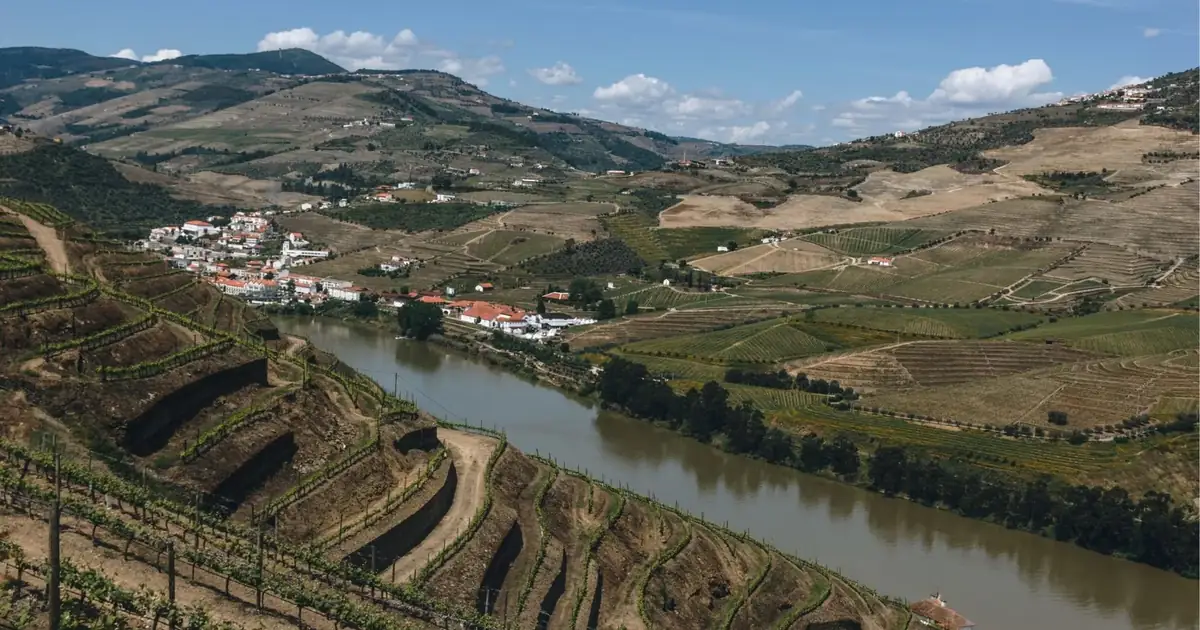
The N222 is the reason the Douro is on lists it would otherwise miss. The 27-kilometre stretch from Régua to Pinhão was named the world’s best driving road in a 2015 Avis study, and while that is a marketing exercise, the road earns it: it runs at mid-height along the south bank, so the terraces rise above you and drop away below at the same time, and the river keeps reappearing around each bend.
Treat it as the spine of the day rather than a transfer. Budget forty minutes for a drive that takes twenty-five, because you will stop. The pull-ins are informal and the best of them are unmarked; the general rule is that the view opens up on the bends where the road turns back on itself, and the finest of those are on the approach to Pinhão, below the ridge at Casal de Loivos.
Do not be afraid to climb. The valley’s best views are almost all from above the road, not on it, and the ten or fifteen minutes it costs to grind up a switchback to a miradouro buys the single image most people came for. Casal de Loivos, on the ridge above Pinhão, is the classic — the view down onto the river bend with terraces stacked to the skyline on both banks.
One practical caveat: the N222 is narrow, has no shoulder in places, and is shared with agricultural traffic and tour coaches. It is not a difficult drive, but it is not one to do having tasted at two estates. Our comparison of the best way to see the Douro Valley from Porto works through the tour, the train, a rental car and a private driver on exactly that point.
Pinhão: the middle of the route
If you only stop once, stop here. Pinhão is a small village — a few hundred people — at the mouth of the Pinhão river, and it is the practical centre of the Cima Corgo, the middle sub-region where most of the best Port is grown. Everything a visitor needs is within a few hundred metres of the water: the station, the docks where the cruises leave, a handful of restaurants and the road up to the ridge.
The railway station is worth five minutes on its own. Its platform walls are lined with azulejo panels installed in the 1930s showing the harvest, the river and the barrel boats, and they are among the most photographed tiles in northern Portugal. The station also matters practically: the Linha do Douro runs from Porto’s São Bento along the river, and the last stretch into Pinhão is one of the better train rides in Europe. It makes a car-free day here entirely realistic — our guide to Pinhão wine tours and tastings covers which quintas are walkable from the platform and which need a taxi.
The other thing Pinhão has is the boat. The stretch of river either side of the village is the most photographed in the valley, and seeing the terraces from the water rather than from a road above them is a genuinely different experience. Pinhão: Douro River Solar Boat Tour with Wine Tasting — 4.81★ from 1,059 reviews, from $23 — is an engine-free hour with two wines poured on board, and it is the cheapest worthwhile thing on this page (breakdown). Our guide to the best Douro river wine cruises sorts the vineyard sailings from the Porto city ones, which are not the same trip.
Pinhão wineries within reach
This is the densest cluster of visitable estates in the region, and the reason the middle of the route is where you should spend your time.
Quinta do Bomfim is the Symington family’s Dow’s estate, and it is the one you can walk to — a few minutes from the station along the riverfront. Quinta das Carvalhas sits across the water on the south bank, climbing from the river to a ridge with one of the valley’s best viewpoints at the top; it belongs to Real Companhia Velha and its vineyard tour is more of a proper walk than most. Quinta de la Rosa is a couple of kilometres downstream, family-owned, with a restaurant and rooms above the river.
Between them they cover the range: a big-house Port operation, a large estate with a view, and a small independent making both Port and dry Douro wine. One of these plus the boat is a complete day. Two is possible if you skip the ridge. All three requires you to have booked in advance and to not want lunch — see our 10 best wineries guide for the comparison, and what to expect at a Douro Valley wine tasting for what actually happens once you are at the table.
For a version of this cluster with the tastings done properly rather than quickly, Porto: Douro Valley Wine Tour with a Sommelier & Boat Trip — 4.98★ from 783 reviews, from $145 — is the highest-rated tour on this site: two family estates, fifteen wines across the day, a sommelier rather than a coach guide, and the same Pinhão river hour (breakdown).
Provesende
Ten kilometres and about twenty minutes above Pinhão, up a road that switchbacks out of the gorge, Provesende is the detour worth making if you have an afternoon rather than an hour. It is one of Portugal’s designated aldeias vinhateiras — wine villages — and it looks it: a granite square with a stone pillory, seventeenth- and eighteenth-century manor houses built by families who made their money in Port, a working village bakery, and almost no commercial infrastructure.
The point of Provesende is that it is the human half of the landscape. Everything else on this route is vineyards and river; this is where the people who owned the vineyards lived, and the scale of the manor houses tells you how much money the trade moved. It takes forty minutes to walk and it recalibrates the rest of the day.
Go in the morning or late afternoon. In the middle of the day in summer it is very hot, very quiet, and most of what is worth seeing is shuttered.
Favaios
Favaios sits on the plateau about 15 km north of Pinhão, and it is on this route for one reason: it makes a different wine. This is the home of Moscatel do Douro, a fortified sweet white from Moscatel Galego Branco, which is a genuinely distinct thing from Port and is made almost nowhere else in the region. The village is also known for its bread — pão de Favaios — and the pairing of the two is the local order.
The Adega Cooperativa de Favaios is one of the largest co-operatives in Portugal and the dominant producer, and the village’s Museu do Pão e do Vinho — the bread and wine museum — covers both trades in one visit. Together they make Favaios the most rewarding non-Port stop on the route, and a useful corrective if two days of tawny has begun to blur.
You do not need a car to taste the wine: the Favaios co-op’s white Moscatel is one of the two wines poured on the Pinhão solar boat cruise, which is the easiest way to try it if the plateau detour does not fit your day. Our guide to Douro Valley wines and what to taste explains where Moscatel sits alongside the Port styles.
Deeper Douro: São João da Pesqueira and beyond
Everything above fits in a day. If you have three or four, the route keeps going east, and it changes character as it does.
São João da Pesqueira is about 25 km beyond Pinhão and marks the transition into the wilder end of the Cima Corgo. The Miradouro de São Salvador do Mundo nearby is a chapel-topped rock outcrop above the Valeira gorge — a narrower, more dramatic stretch of river than anything downstream, and historically unnavigable until the rock was blasted out in the 1790s.
Past that is the Douro Superior, the easternmost and by far the hottest and driest of the three sub-regions, running to the Spanish border. It is emptier, the estates are further apart, and the vineyards give way to almond and olive between them. Two things anchor it: Vila Nova de Foz Côa, where the Côa Valley’s open-air Palaeolithic rock engravings are a UNESCO World Heritage site in their own right, and Barca d’Alva at the frontier, where the river cruise ships turn around.
Be honest with yourself about the time. Foz Côa is about two and a half hours from Porto each way, and doing it as a day trip means five hours in a car to see rock art and no wine. It belongs to a second or third Douro trip, not a first one.
The route at a glance
| Stop | Sub-region | Why stop | Time needed |
|---|---|---|---|
| Peso da Régua | Baixo Corgo | Museum, context, restaurants, the practical base | 1–2 hours |
| Miradouro de São Leonardo de Galafura | Baixo Corgo | The view Régua itself doesn’t have | 30 min + drive |
| The N222 | — | The drive is the attraction | 40 min with stops |
| Pinhão | Cima Corgo | Quintas, the river cruise, the tiled station | Half a day |
| Casal de Loivos | Cima Corgo | The classic view over the Pinhão bend | 20 min + climb |
| Provesende | Cima Corgo | Granite wine village, manor houses | 40 min + drive |
| Favaios | Cima Corgo | Moscatel do Douro and bread | 1–2 hours |
| São João da Pesqueira | Cima Corgo | Valeira gorge, São Salvador do Mundo | Second day |
| Vila Nova de Foz Côa | Douro Superior | UNESCO rock art | Second or third trip |
FAQ
Can I drive the whole Douro wine route in one day? No, and trying is the standard first-visit mistake. The demarcated region runs roughly 100 km east to west and the roads are slow. One or two wineries plus scenery and a proper lunch makes a far better day than maximum mileage — you will taste more and drive less. Pick the Régua–Pinhão stretch and do it properly.
What is the best section of the Douro for a first visit? The N222 between Peso da Régua and Pinhão. It has the most concentrated scenery, the highest density of visitable quintas, the river cruises, and a railway station at each end. Everything further east is better on a second trip.
Do I need a car to follow the wine route? No. The Linha do Douro railway runs from Porto to both Régua and Pinhão along the river, and several quintas near Pinhão are walkable or a short taxi from the station. What the train cannot give you is the N222 itself or the hill villages — those need a car, a taxi or a guided tour. Our tour vs train vs car comparison works through the trade-offs.
Is Provesende or Favaios worth the detour? If you have a car and a full day, yes — one of them, not both. Provesende for the architecture and the sense of who owned the valley; Favaios if you want to taste something other than Port. Both involve a climb out of the gorge of fifteen to twenty-five minutes each way.
Which stops need to be booked in advance? The wineries, without exception. Most Douro quintas run visits at set times with limited places and many will not take walk-ins, particularly in summer and during the September–October harvest. Villages, viewpoints and the road need nothing. See our season-by-season guide for when the pressure is worst.
How long is the drive from Porto to the Douro Valley? About an hour and a half to Peso da Régua on the A4/IP4, and closer to two hours to Pinhão. That is motorway, not scenery — the valley proper starts east of Régua. Allow seven to ten hours door to door for a full day.
Ready to book the day rather than plan it? Our guide to choosing the best Douro Valley wine tour from Porto compares the six tours on this site, what to expect on a Douro Valley tour walks through the shape of the day, and Douro Valley wine tours with lunch covers the one inclusion that varies most between operators. Or compare everything on the homepage.
Taste the Douro — Wine, Boat & Lunch, One Day
Join 22,000+ travelers who rated this trip 4.7/5. Two wine estates, a river cruise, and a traditional Portuguese lunch — all included. Free cancellation.
Check Availability & Book